MOE and SEAB are using AI in saffolding language learning, self learning chatbot to improve composition and help with some teacher administrative works like personal comment generation for report books. The application of AI in teaching, learning, and administration is slowing changing the way teachers do their job.
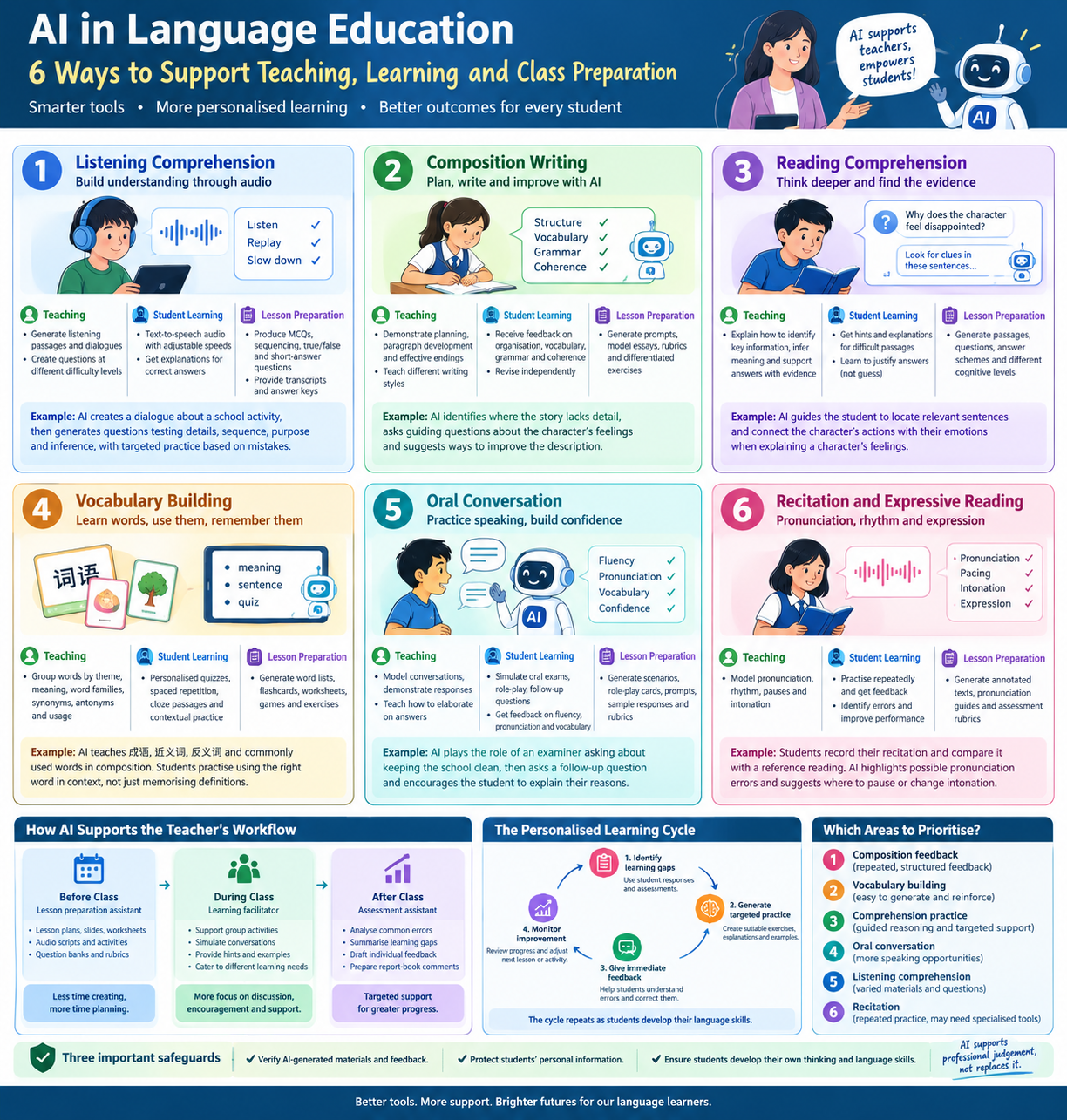
Six areas of AI application in Chinese language education

1. Listening comprehension
Personalised practice
How AI can help
- Teaching: Generate listening passages, dialogues, audio scripts and questions at different difficulty levels.
- Student learning: Provide text-to-speech audio at adjustable speeds, replay difficult sections, and explain why an answer is correct.
- Lesson preparation: Create multiple-choice, sequencing, true-or-false and short-answer questions, together with answer keys and transcripts.
Example: Students listen to a dialogue between two friends planning a school activity. AI generates questions testing details, sequence, purpose and inference, then provides targeted practice based on mistakes.

2. Composition writing
AI writing coach
How AI can help
- Teaching: Demonstrate planning, paragraph development, descriptive writing, dialogue and effective endings.
- Student learning: Give feedback on organisation, vocabulary, grammar, sentence variety and coherence without immediately rewriting the entire composition.
- Lesson preparation: Generate writing prompts, picture-composition scenarios, model essays, marking rubrics and differentiated writing exercises.
Example: A student writes a composition about helping a classmate. AI identifies where the story lacks detail, asks guiding questions about the character’s feelings and suggests ways to improve the description. The student revises the work independently.

3. Reading comprehension
Reasoning and inference
How AI can help
- Teaching: Explain how to identify key information, infer meaning, understand characters’ motives and support answers with textual evidence.
- Student learning: Provide hints, explain unfamiliar passages and teach students to justify their answers instead of guessing.
- Lesson preparation: Generate passages, comprehension questions, answer schemes and questions at different levels of cognitive difficulty.
Example: When a student cannot explain why a character feels disappointed, AI guides the student to locate relevant sentences and connect the character’s actions with their emotions.

4. Vocabulary building
Adaptive learning
How AI can help
- Teaching: Group words by theme, meaning, word families, synonyms, antonyms and common usage.
- Student learning: Create personalised quizzes, spaced-repetition exercises, cloze passages, example sentences and contextual vocabulary practice.
- Lesson preparation: Generate word lists, flashcards, worksheets, differentiated exercises and vocabulary games.
Example: For Chinese language learning, AI can teach 成语, 近义词, 反义词 and words commonly used in composition. Students practise selecting the right word for a given context rather than merely memorising definitions.

5. Oral conversation
Interactive speaking partner
How AI can help
- Teaching: Model conversations, demonstrate appropriate responses and teach students how to elaborate on their answers.
- Student learning: Simulate oral examinations, role-play everyday situations, practise follow-up questions and receive feedback on fluency, pronunciation and vocabulary.
- Lesson preparation: Generate conversation scenarios, role-play cards, oral prompts, sample responses and assessment rubrics.
Example: AI plays the role of an examiner asking a student about keeping the school clean. After the student’s response, AI asks a follow-up question and encourages the student to explain their reasons and provide a personal example.

6. Recitation and expressive reading
Pronunciation and fluency
How AI can help
- Teaching: Model pronunciation, rhythm, pauses, intonation and expressive reading.
- Student learning: Allow students to practise reciting poems, passages or speeches repeatedly and receive feedback on pronunciation, omissions and pacing.
- Lesson preparation: Generate annotated texts, pronunciation guides, listening models, recitation exercises and performance assessment rubrics.
Example: Students recite a Chinese poem and compare their recording with a reference reading. AI highlights possible pronunciation errors and suggests where pauses or changes in intonation may improve expression. Accuracy should be checked against the original text and a reliable pronunciation reference.
Conclusion
AI is going to stay and it will continuouily change the educational sector. Teacher must adapt and adopt to stay relevance to this innovation.